How to prepare for the DALF C1
Published on
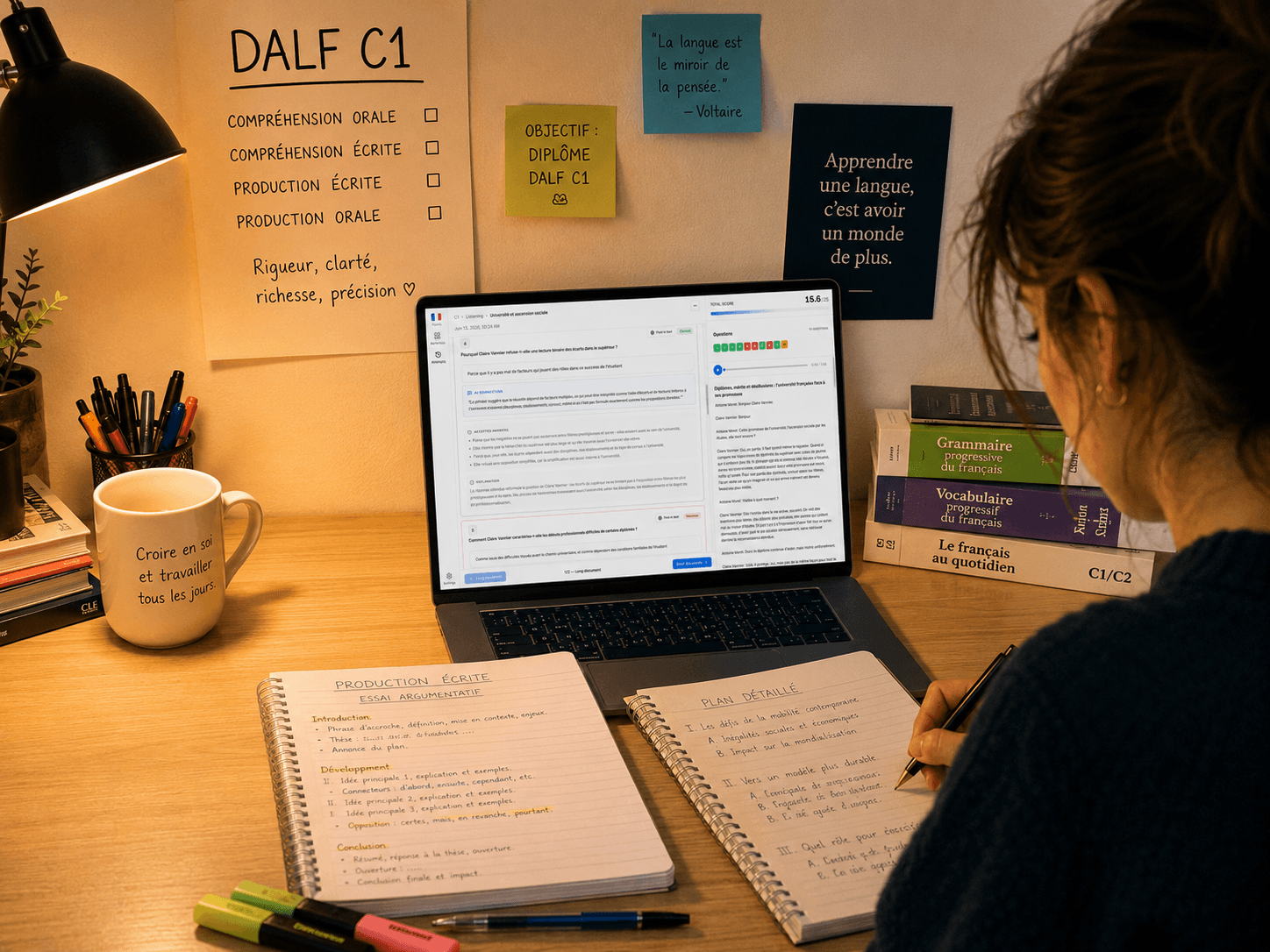
Preparing for the DALF C1 and want to know what awaits you on exam day? This article covers the official structure of all four sections: durations, documents, and instructions, so you can picture the experience before you enter the exam room.
DALF C1 at a glance
The DALF (Diplôme Approfondi de Langue Française) certifies autonomous mastery of French, suited to university and professional life. Unlike the DELF, there is no intermediate level: you go straight to C1 on the Common European Framework of Reference.
The exam assesses four distinct skills, each scored out of 25 points, for a total of 100. To earn the diploma, you generally need 50 points overall and at least 5 points per section. A high score in one skill does not offset a failing score in another.
- Sections
- 4 skills
- Scoring
- /25 each
- Pass threshold
- ≥ 50 / 100
- Grouped duration
- ≈ 4 h
The first three sections (reading comprehension, listening comprehension, and written production) usually take place on the same day, in a group session. The oral production section is individual: you receive your documents in advance, have one hour to prepare alone, then appear before a panel of two examiners.
Structure of the C1 sections
Each section contains the following, in the order you will most likely encounter them on exam day.
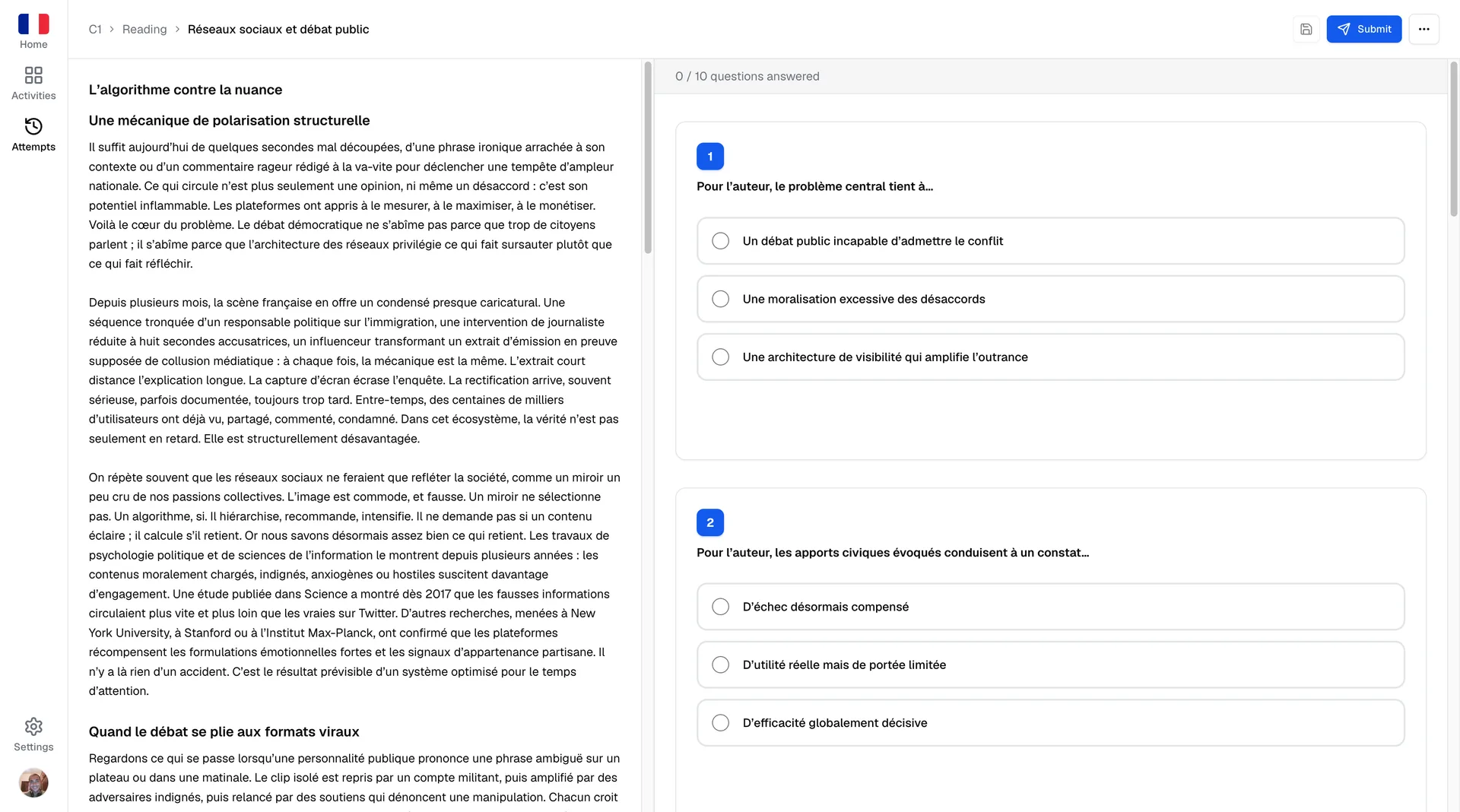
1. Reading comprehension: 50 minutes
This section has one exercise. You read an argumentative text (literary or journalistic) of 1,500 to 2,000 words, then answer questions testing global and detailed comprehension.
Expect a dense text with sophisticated vocabulary and nuanced argumentation. Questions test your ability to identify the thesis, sub-arguments, and implicit meaning, including what is left unsaid.
2. Listening comprehension: 40 minutes
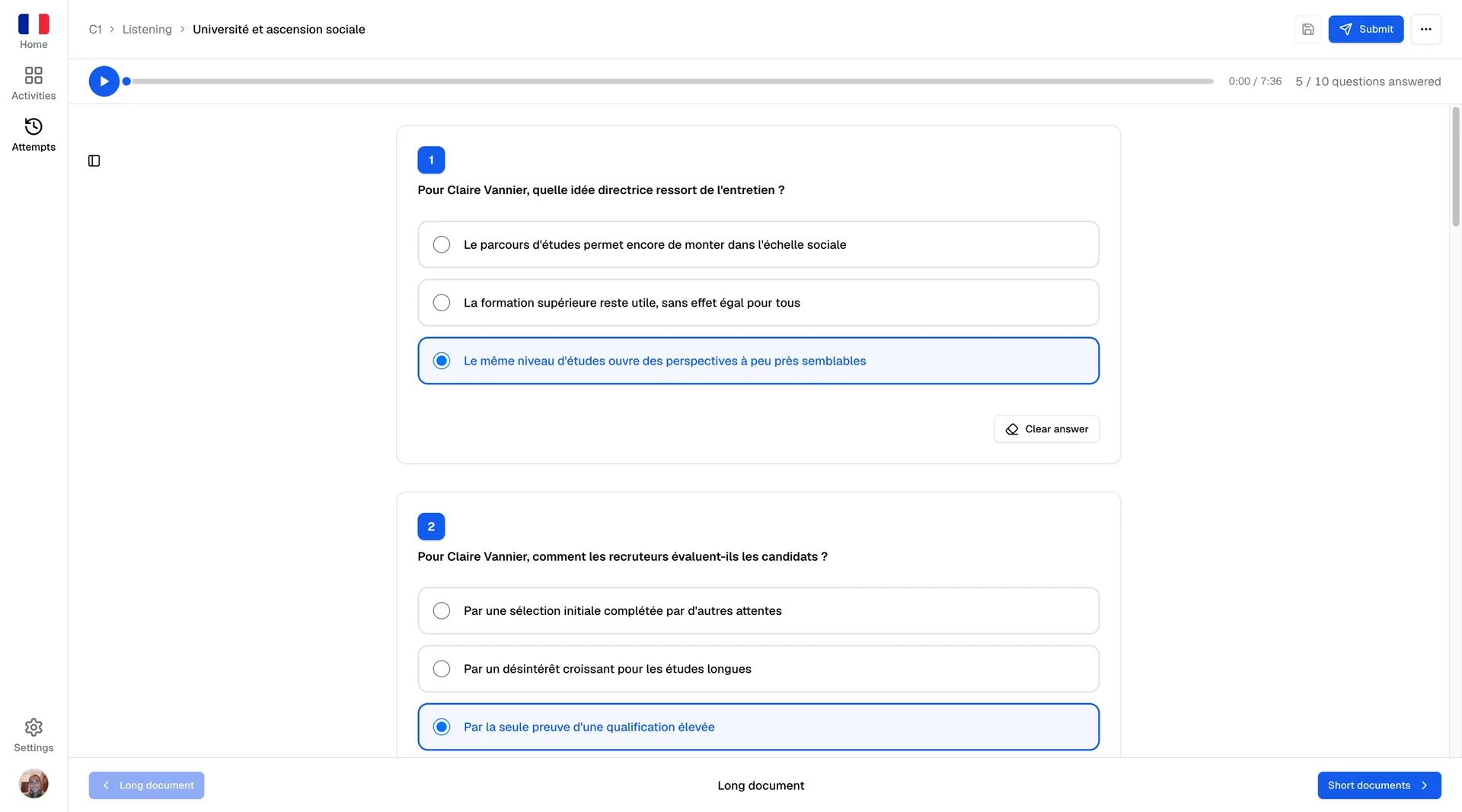
This section has two exercises, totaling about 10 minutes of recordings:
- Exercise 1: long document (interview, lecture, conference…): you listen twice.
- Exercise 2: two short documents (news flashes, polls, announcements…): one listen each.
After each document, you answer questions. Remaining time is for reviewing your answers and completing items left blank after the first listen of the long document.
3. Written production: 2 h 30
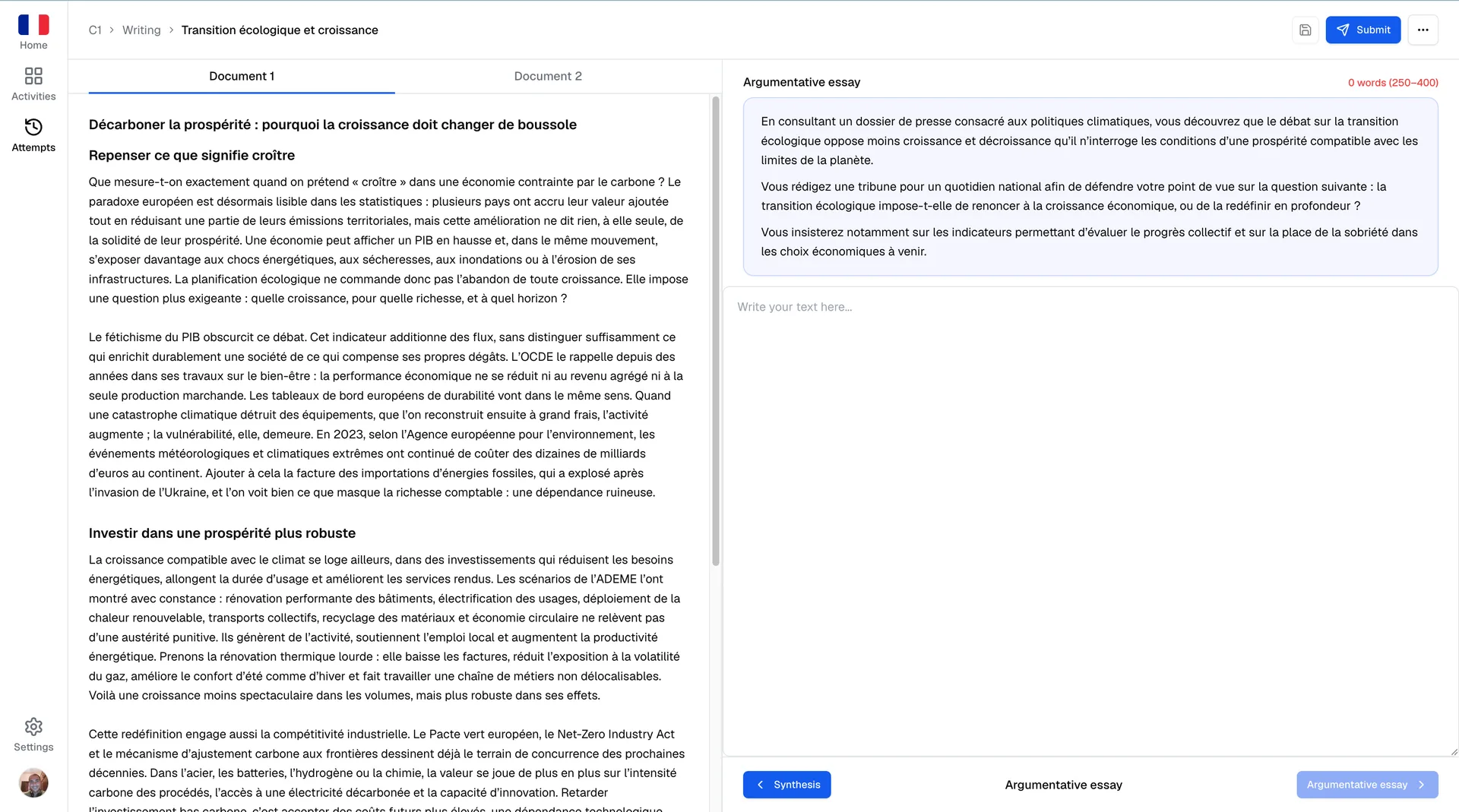
This is the longest section. You must produce two distinct texts from a dossier of documents on the same theme. Split your time between the synthesis and the essay. Don't spend everything on the first text.
Part A: Synthesis (200 to 240 words)
From the documents provided, you write a synthesis of about 220 words. The goal is to identify the main ideas, organize them around the common theme, and rephrase them in your own words in a fluent, coherent text, as if the reader had never seen the sources.
- Produce one structured text, not two summaries side by side.
- Do not add personal ideas beyond what the documents contain.
- You may reuse key terms, but not whole sentences.
Part B: Argumentative essay (250 to 400 words, 12 points)
The essay is directly linked to the synthesis. Depending on the prompt, you may write a contribution to a debate, a formal letter, a critical article, a report, etc. You must take a position and argue to defend your ideas. You may reuse elements from the dossier by making them your own.
Read the prompt and trigger document carefully: identify the theme, expected document type, keywords, and main idea. Nuance your opinion, illustrate with examples, and plan time for proofreading.
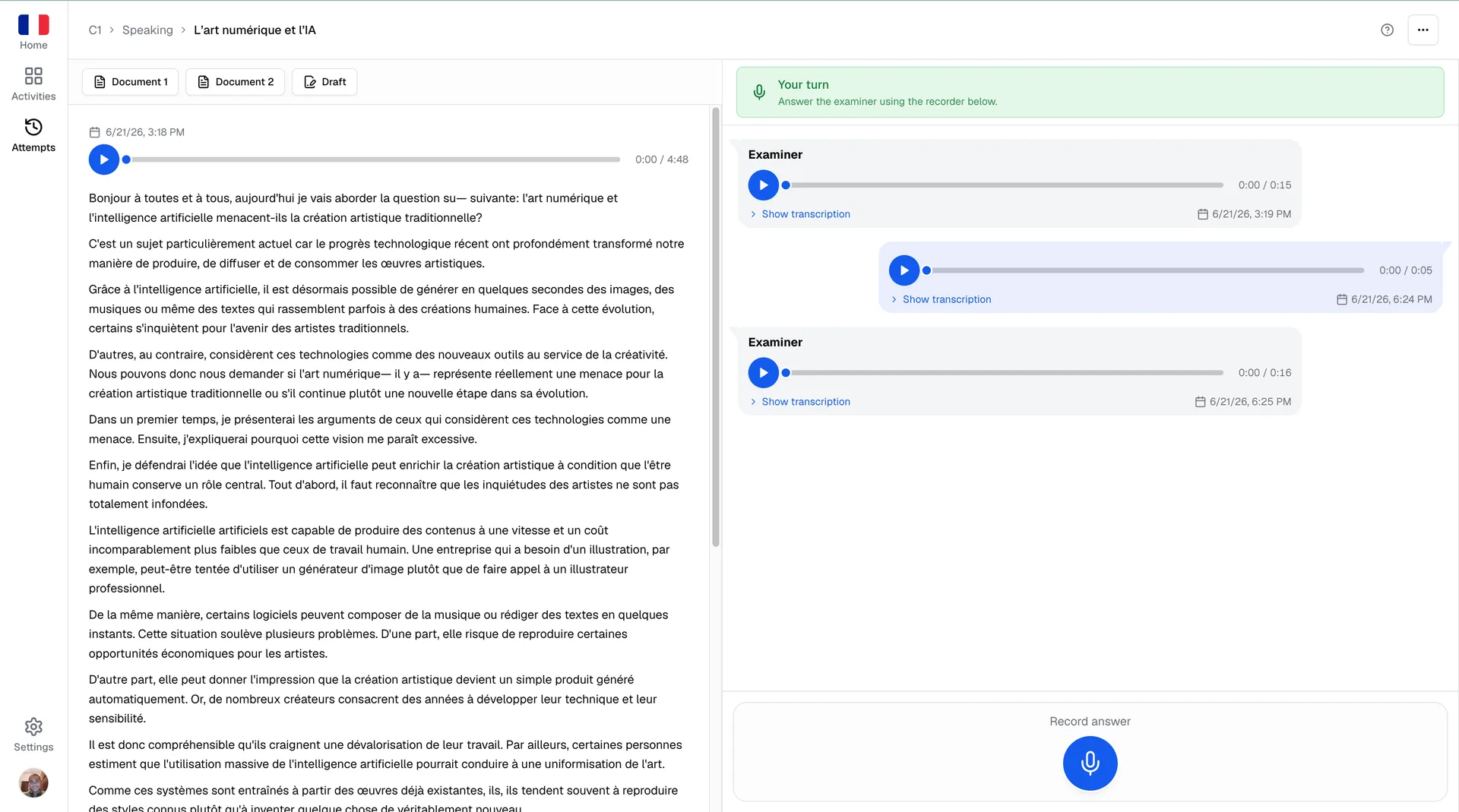
4. Oral production: preparation + 30 minutes max
The oral section unfolds in two parts, before a panel of two examiners. You receive two complementary texts (literary or journalistic) on the same theme.
- Solo preparation
- 1 hour
- Presentation
- 8 to 10 min
- Interview
- 15 to 20 min
Phase 1: Presentation (8 to 10 minutes)
Using the two documents, you prepare a presentation on the given theme. You must identify the common theme, formulate a problem statement, then defend your viewpoint with arguments and examples. Your presentation is structured (introduction, development, conclusion) and covers 3 or 4 key points at most.
The documents serve as source material: use their content (lines of thought, information, examples) while adding your own comments and ideas. Don't settle for a simple summary.
Phase 2: Interview (15 to 20 minutes)
Next, the panel asks questions and discusses the content of your presentation with you. Show that you understand and respond to the examiner's points. You may nuance, expand, and defend a position, including one different from the examiner's.
Summary
The DALF C1 rewards regular practice under real conditions. Knowing each section's structure (durations, document types, examiner expectations) helps you avoid surprises and manage your energy.
| Section | Duration | Key format |
|---|---|---|
| Reading comprehension | 50 min | 1 text (1,500–2,000 words) + questions |
| Listening comprehension | 40 min | 1 long (×2) + 2 short (×1) |
| Written production | 2 h 30 | Synthesis (200–240 words) + essay (250–400 words) |
| Oral production | 1 h prep + 30 min max | Presentation (8–10 min) + interview (15–20 min) |