DELF B2 Speaking Topics from Official Sample Papers
Published on
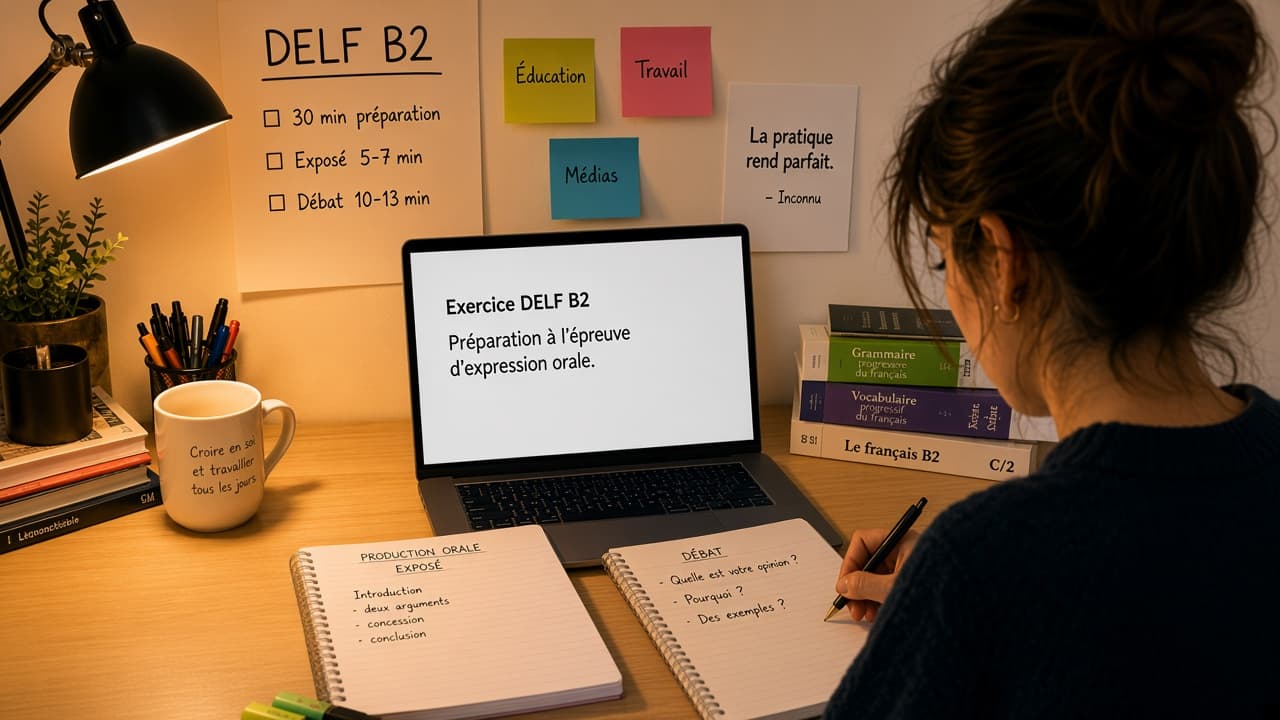
France Éducation international does not publish a closed list of DELF B2 speaking topics. Official sample papers keep returning to education, work, and media / digital society. In the production orale, you draw two sujets, choose one, and prepare for 30 minutes. The jury slot is 20 minutes: an exposé of 5-7 minutes, then a débat of 10-13 minutes.
There is no official list of DELF B2 speaking topics
France Éducation international does not keep a downloadable catalogue of oral prompts. The official grille for this épreuve covers thèmes de société: current social issues a B2 speaker can argue. There is no numbered bank.
Candidates search for DELF B2 speaking topics because they want a finite list they can memorise. Train on the format and the published samples. Do not train on a sitting leak.
Posts that sell "50 official sujets" or seven official categories claim more than France Éducation international publishes.
Sample booklets show several prompts, and the jury may set some sujets aside, so even a booklet is not your sitting. Titles change every sitting.
What repeats is the kind of debate. There is no canon of titles. Official descriptions and sample papers come back to work, health, the environment, education, and technology. Treat those as recurring thèmes. France Éducation international does not publish them as a taxonomy.
Use the published exemples de sujets as practice. They will not forecast the paper at your centre. Do not memorise them as tomorrow's paper.
B2 production orale timing
The B2 production orale is a present-and-defend task with a fixed clock, not a 10-minute monologue.
You draw two sujets. Each comes with a short trigger document. You choose one and prepare for 30 minutes, then sit with the jury for 20 minutes. Present and defend a point of view. Do not recap the document.
France Éducation international splits those 20 minutes into an exposé of 5-7 minutes and a débat of 10-13 minutes. Guides that stretch the exposé towards 10 minutes use the wrong clock.
- Preparation
- 30 min
- Jury slot
- 20 min
- Exposé
- 5–7 min
- Débat
- 10–13 min
| Stage | Time |
|---|---|
| Draw two sujets and choose one | Start of the épreuve |
| Preparation | 30 minutes |
| Jury slot (total) | 20 minutes |
| Exposé | 5-7 minutes |
| Débat | 10-13 minutes |
If the exposé ends at minute four, you still sit the débat. If you talk through minute eight, you steal time from the exchange. Practise both halves against this table.
Three families from official sample papers
Nine titles below come from official B2 sample papers (tout public and junior/scolaire exemples de sujets). Grouping them into education, work, and media / digital society is an editorial map of those papers. France Éducation international does not publish that category list.
France Éducation international does not use a heading that says "education, work, media". Examiner sheets list individual sujets. The families let you rehearse the same kind of argument on related prompts.
Education
Official samples include L’école en demande-t-elle trop aux parents ?, Le rôle de l’université est-il de préparer à un métier ?, and Partir à l’étranger dès le lycée. The debate is who educates, what a diploma is for, and when a young person should leave home. School, university, and early mobility are thèmes de société. The épreuve is not a quiz on the French system.
Work
Official samples include Est-ce que le travail, c’est le bonheur ?, Le télétravail, une solution durable ?, and Travailler moins pour vivre mieux. These sujets ask what work is for, where it happens, and how much of a life it should occupy. Happiness at work, remote days, and a shorter week are social questions.
Media / digital society
Official samples include Les réseaux sociaux font partie de la vie des ados, Peut-on tout dire et tout diffuser sur internet ?, and Peut-on vivre sans télé ?. The debate is how public a private life should be, and what still counts as shared culture when screens multiply. Adolescent use, publication, and television belong to the same thème.
How to practise without a leaked question bank
Practise the task on official exemples de sujets. On the day, the titles will not match, because France Éducation international changes prompts every sitting.
Use the 30/20-minute clock on a real sample: 30 minutes with the trigger document, then a 5-7 minute exposé and a 10-13 minute débat. Record whether you presented a point of view or retold the text. Retelling the text misses the task.
Rehearse the three families as thèmes. A stance you can recycle on education or work will survive a new heading. A memorised sentence from a sample will not.
Refuse a banco de preguntas, Alliance Française centre leaks, and dated dumps that name a sitting, a city, or a month. Those lists are not France Éducation international material. They train you to hunt a title. Build an argument you can reuse when the title is new.
Unofficial corrigés of the oral are not answer keys. There is no official oral answer sheet. A model exposé you found on a blog is one possible stance. The jury will still ask you to defend yours.
If you are moving up a level, the DALF C1 oral is a different task. It has longer source material, a different clock, and no B2-style draw-two-choose-one. Do not reuse this B2 inventory as C1 prep.
Mistakes that waste prep time
- Treating "50 official sujets" as France Éducation international's official list. FEI does not publish a closed list. A long blog inventory is a compilation. It is not the grille.
- Memorising titres instead of argument structure. The nine titles above will almost certainly not be the two you draw. A reusable shape (stance, two reasons, one concession, a closing line) travels. A memorised paragraph on télétravail does not.
- Using unofficial oral corrigés as keys. There is no official key for the production orale. A fluent model can show register. It cannot tell you what your jury will accept.
- Hunting a named sitting. "What came up in March at centre X" is a leak request. Redirect yourself to official sample papers. Prompts change and the task stays the same.
FAQ
Is there a FEI PDF of all DELF B2 speaking topics?
No. France Éducation international publishes the grille, the format of the épreuve, and exemples de sujets. It does not publish a complete inventory of oral prompts. Any PDF that claims to be the full official bank is a compilation of titles. It is not an FEI catalogue.
Are there official oral answers?
No. The production orale has no official corrigé you can tick against. Sample papers give the trigger and the consigne. They do not give a model exposé or a key for the débat. Treat third-party "answers" as practice scripts. They are not official keys.
Do the same sujets come back every sitting?
No. Prompts change every sitting, and the jury may set some sujets aside. Recurring thèmes de société (work, education, media) can look familiar from sample papers. The title in front of you that day will still be new. Practise the task. A recycled heading will not be the one you draw.